 Free live webinar: Thursday, Nov 12
Stop renewing certificates by hand
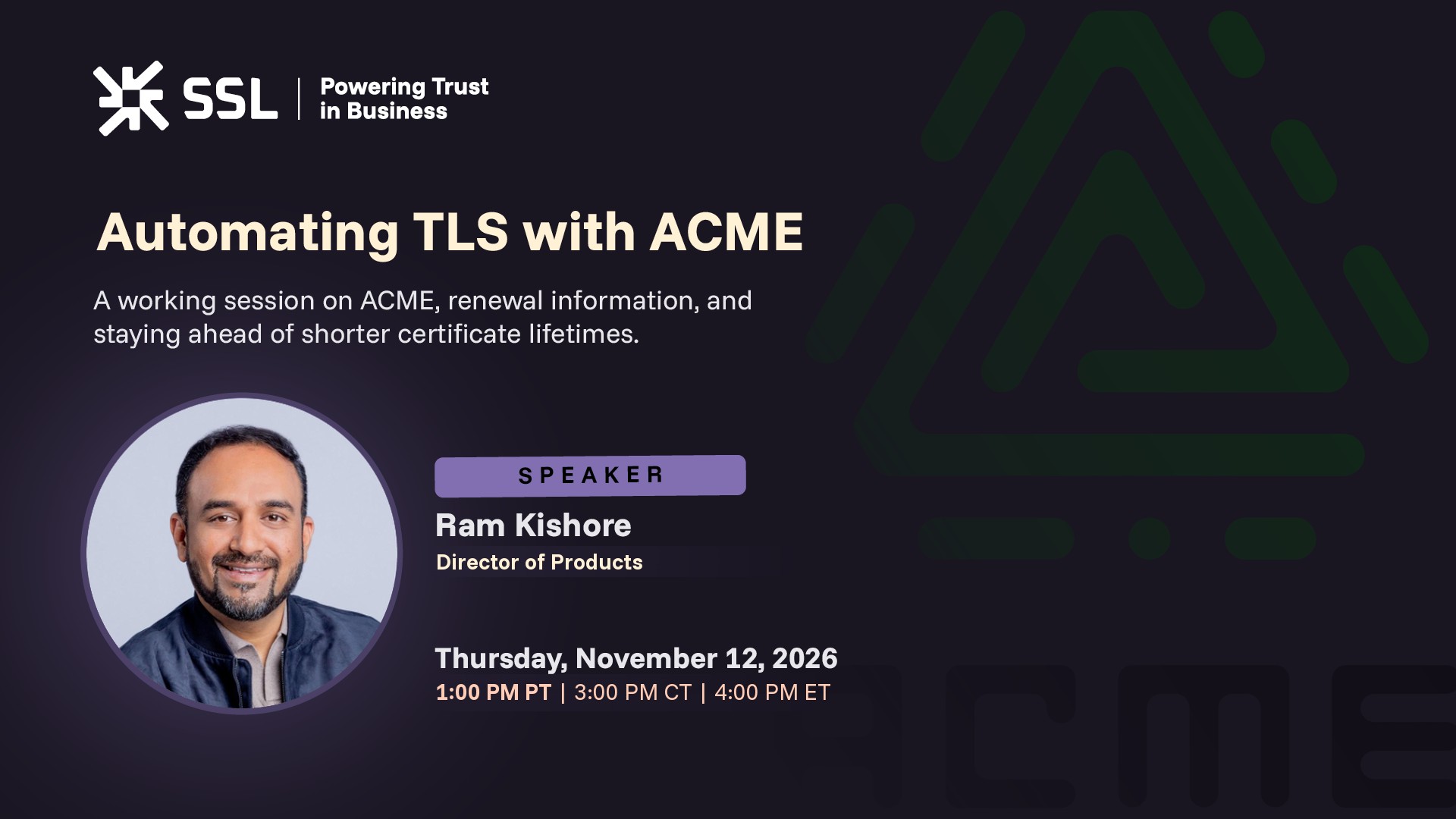
Certificates are heading to 47-day lifetimes. Ram Kishore shows how ACME lets your servers renew them on their own, and what it takes to get there.
For security, infrastructure and IT leaders who keep a company's websites, applications and devices running on certificates.
Four things Ram covers
The arithmetic
A company with 1,000 certificates renews about 1,800 a year today and about 7,800 a year at 47 days. Ram shows why the calendar reminder that works now stops working.
How ACME does the renewing
Your server asks for a certificate, proves it controls the name, and installs the result. The same exchange repeats at every renewal with nobody involved.
A rollout with no change freeze
Start with one low-risk service, expand by where your encryption is set up, then make automatic renewal the default for anything new.
What SSL supports today
Every SSL ACME directory publishes renewal information. Two changes get you started: point your client at our directory with your account credentials, then let the renewal window set the timing.
Certificates are about to renew four times as often
Public certificates are moving to a 47-day lifetime by March 2029. A company with 1,000 certificates renews about 1,800 a year today and about 7,800 then. ACME, the same standard Ram teaches, is how servers renew their own.
Source: CA/Browser Forum Ballot SC-081v3, Baseline Requirements.
SSL was founded in 2002, maintains WebTrust audit compliance, and has been a full voting member of the CA/Browser Forum, the group that sets the rules public certificates follow, since August 3, 2017.

Ram Kishore
Director of Products, SSL
Ram works on certificate automation at SSL. He walks through the setup step by step, from the first client to a rollout across every place you terminate encryption.