

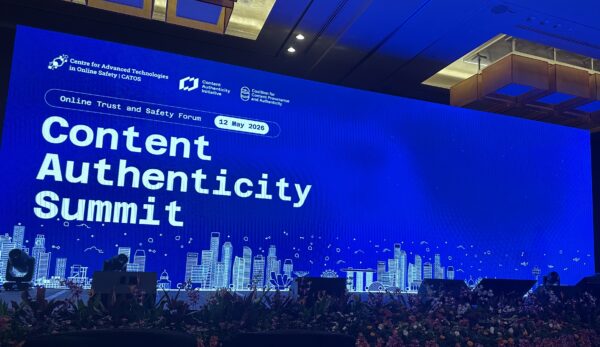

The conversation around content authenticity has moved far beyond theoretical and become technical, urgent, and global. That theme was on full display at the Online Trust & Safety (OTS) Forum 2026: Content Authenticity Summit, held in Singapore and organized by the Centre for Advanced Technologies in Online Safety (CATOS), co-organized with the Content Authenticity Initiative (CAI), and supported by the Coalition for Content Provenance and Authenticity (C2PA).
Building on the inaugural OTS Forum in 2024, this year’s edition shifted the focus from detecting online harms to preventing them and building long-term resilience. The Content Authenticity Summit brought together policymakers, platforms, media organizations, and implementers from around the world to explore practical, interoperable approaches to content authenticity in the AI era. Attendees included newsrooms, brand teams, compliance officers, government communicators, and technology developers.
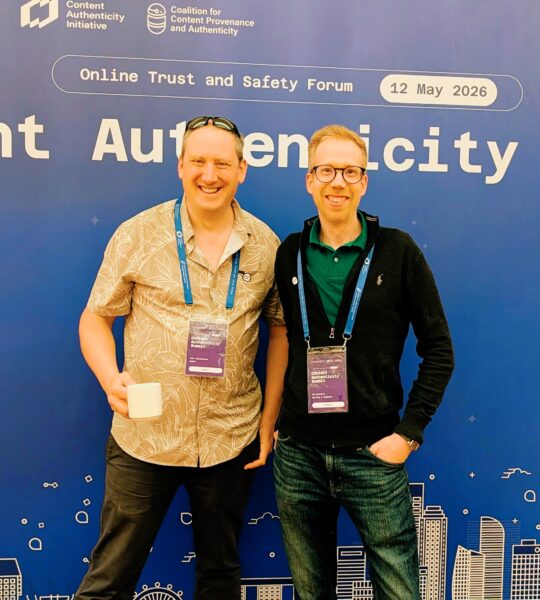
In addition to partnering with Adobe and Digimarc for the event, SSL sent a three-person team to Singapore: Dom Guinard, Director of Product for Content Authenticity and IoT and co-chair of the C2PA watermarking workgroup; Ram Kishore, Global Head of Solutions Architecture; and Jolen Rey Sebala, Senior Account Executive. Dom also took the stage as a presenter, highlighting SSL in the content authenticity space, where the company has staked out an early, prominent position.
A Shift From Detection to Prevention
One of the clearest signals from the event was a broader change in how the industry thinks about the content lifecycle as a whole. Ram Kishore noted that the message came through repeatedly across sessions.
“There is a shift in the way that we must view the content lifecycle. It was addressed that we need to strengthen trust much earlier, rather than focusing solely on detection, which is primarily what we do today. We must also look at how we can prevent various kinds of illicit synthetic content, while also bringing provenance by design to the entire media lifecycle.”
As Dom Guinard observed, the community has moved past asking what C2PA is about and is progressing into the next phase.
“Past event discussions on C2PA were centered on what it is, and what it can do. Now it is really about implementation, what building blocks are needed, and how organizations can make it work,” he stated.
Dom also highlighted Canon’s landmark reveal at the event. “Canon announced their implementation of C2PA-ready camera models, the EOS R1 and the EOS R5 Mark II. The architecture is also interesting because Canon provides long-term validation via a cloud service that timestamps the assets, which resolves the issue with a lack of permanent connectivity on cameras. They are fully committing to C2PA with this investment.”
Dom Guinard Takes the Stage: Making Content Credentials Stronger
Dom presented “Making Content Credentials Stronger,” a technical deep dive co-branded with SSL and Digimarc, covering two pillars: durability through digital watermarks and trustworthiness through C2PA certificates.
On the watermarking side, Dom explained how digital watermarks strengthen C2PA manifests by enabling recovery, preventing adversarial swaps, and addressing emerging regulations requiring durable flagging of AI-generated content. Starting with C2PA 2.2, the standard introduced the Soft Binding Resolution API, a mechanism that allows a watermarked asset to recover its corresponding C2PA manifest even after the manifest itself has been stripped or lost.
On the certificate side, Dom walked through the C2PA Trust List, live since January 2026, and the four-step validation chain it enables: fetching the trust list, verifying the chain back to a trusted root CA, checking revocation via OCSP, and confirming signing time through a Time Stamping Authority (TSA) counter-signature. He also distinguished between the three certificate roles in the ecosystem: the C2PA Signing Certificate that identifies the product or vendor, the CAWG Identity Certificate (read more about the differences between these two levels here) that asserts the human or organizational identity behind the asset , and the Timestamp Authority (TSA) Certificate that enables long-term validation.
SSL’s own C2PA tooling featured prominently: c2pasign.com for testing certificate issuance before going conformant, a free-tier TSA endpoint for testing and low-volume use, and C2PA.sh, a beta validator that surfaces trust chain details, OCSP status, timestamps, and signature information in a single provenance report.

Conversations From the Floor
Jolen Rey Sebala spent much of the event at the SSL booth, connecting with attendees from the media and government sectors.
“Many of the attendees I interacted with were directly involved in media production, so they were highly interested in learning more about C2PA,” Jolen said. “We were able to connect with regional content producers, news agencies, and members from the Agency for Science, Technology and Research (A*STAR).”
The audience interest he described lines up with what Ram and Dom observed in the formal sessions. Hany Farid, a well-known researcher and American university professor who leads a team that specializes in analyzing digital imagery and assessing whether viral content is AI-generated, delivered a session that underscored the stakes. Ram called it one of the day’s highlights: “He was sharing how much generative AI has improved in creating synthetic media, mostly fabricated content, and how realistic this imagery has become. We’re at a point where it is crucial for us to have something like C2PA Content Credentials when separating real content from synthetic content.”
Dom echoes that urgency. “Soon it’s going to be extremely difficult for you and me to distinguish generative content from real content, which really emphasizes the momentum for C2PA.”
SSL and the Future of Content Authenticity
SSL has been a first mover in the C2PA space, becoming the first publicly trusted Certificate Authority to issue production-ready, C2PA-conformant certificates. The CAI OTS Forum reinforced that the market is catching up fast. Governments are asking the same questions that newsrooms and brands are, and the answer is increasingly routed through trusted PKI infrastructure.
To learn more about SSL’s Content Authenticity offerings, contact our team below: