Your organization relies on digital certificates every single day. They authenticate users, secure communications, protect code integrity, and enable trust across your digital ecosystem. But is your Public Key Infrastructure (PKI) actually ready to handle tomorrow’s challenges?
PKI maturity assessment is not just another compliance checkbox. Think of it as a comprehensive health check for one of your organization’s most critical security foundations.
What Is a Digital Maturity Assessment for PKI?
A digital maturity assessment for PKI is a structured evaluation of how well your organization manages its certificate infrastructure. It examines everything from your current processes and technology to your governance policies and strategic planning capabilities.
Unlike a basic security audit that might focus on vulnerabilities or compliance gaps, a PKI assessment takes a broader view. It asks: Are you simply keeping the lights on, or are you positioned to adapt, scale, and optimize your certificate infrastructure as your business evolves?
The goal isn’t to pass or fail. Instead, it’s about understanding where you stand today and mapping out a realistic path forward. Some organizations discover they’re more mature than they thought. Others realize they’ve been one certificate expiration away from a business-disrupting outage.
Understanding the PKI Maturity Model
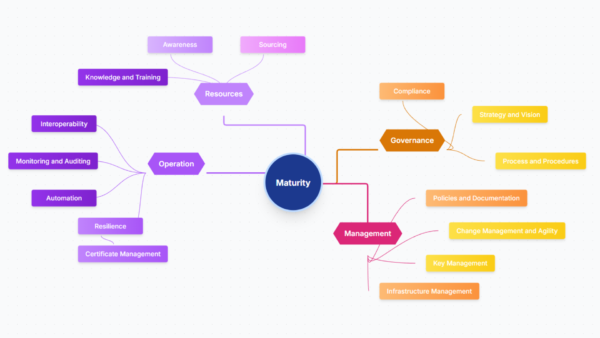
The PKI Maturity Model provides a framework for evaluating your organization’s certificate management capabilities. Initially developed by industry experts and standardized by organizations such as the PKI Consortium, this model helps businesses benchmark their practices against established best practices. The organization also offers a wide variety of PKI assessment tools available for free on its site.
Think of the PKI Maturity Model as a roadmap with clearly defined stages. Each level represents a different degree of sophistication in deploying, managing, and governing your PKI infrastructure. The model recognizes that organizations have different needs. For example, a startup with 50 employees doesn’t need the same certificate infrastructure as a global financial institution.
What makes the maturity model valuable is that it’s prescriptive without being rigid. It acknowledges that moving from one level to the next requires investment in people, processes, and technology. Additionally, it also shows you exactly what those investments should look like.
The 5 Levels of PKI Maturity
Here’s how most organizations progress:
Level 1: Initial – At this initial stage, certificate management is reactive and manual. There’s no centralized visibility into what certificates exist, when they expire, or who’s responsible for them. Teams often discover certificates only when something breaks. Renewals happen through informal processes, and there’s limited documentation.
Level 2: Basic – Organizations at this level have started implementing some structure. There’s at least one person or team responsible for certificates, and perhaps a spreadsheet tracking critical assets. Basic policies exist, even if they’re not consistently followed. Certificate requests follow a defined (if still manual) process.
Level 3: Advanced – At Level 3, organizations have documented policies and standardized procedures for the entire certificate lifecycle. Automated discovery tools provide visibility across the environment. There’s formal governance, defined roles and responsibilities, and integration with identity management systems.
Level 4: Managed – Now we’re talking about mature PKI operations. Certificate management is largely automated, from issuance through renewal and revocation. Comprehensive monitoring and alerting prevent surprises. Metrics drive continuous improvement, and the organization can demonstrate compliance-readiness. Integration with DevOps and cloud infrastructure is seamless.
Level 5: Optimized – The grail status of PKI maturity. Organizations at this level treat certificate infrastructure as a strategic business enabler rather than just a security requirement. They’re innovating with short-lived certificates, implementing zero-trust architectures, and preparing for future challenges, such as post-quantum cryptography (PQC). They benchmark against industry peers and continuously refine their practices.
Why PKI Maturity Matters (More Than Ever)
The stakes for PKI maturity have never been higher. Certificate-related outages regularly make headlines, causing everything from website downtime to manufacturing shutdowns. The average cost of a single incident can reach millions of dollars and cause irreparable reputation damage.
But another pressing concern on the horizon is the quantum threat. Organizations with mature PKI infrastructures are better positioned to migrate to post-quantum cryptographic algorithms when that transition becomes necessary. If you’re still manually tracking certificates in spreadsheets, adding crypto-agility to face PKI PQC challenges will be exponentially harder.
Meanwhile, the volume and complexity of certificate use continue to explode. Cloud migrations, IoT devices, and DevOps pipelines all require certificates, often with increasingly short validity periods. Without mature processes and automation, managing this sprawl becomes impossible.
Does Your Organization Need a PKI Assessment?
Consider a PKI maturity assessment if any of these sound familiar:
- You’ve experienced certificate-related outages or near-misses with expiring certificates
- You’re planning a major digital transformation, cloud migration, or M&A activity
- Compliance audits consistently flag certificate management issues
- You have limited visibility into how many certificates you actually have
- Certificate requests create bottlenecks that slow down development teams
- You’re unsure how prepared you are for emerging threats or technology shifts
- Multiple teams manage certificates independently without coordination
- You’re evaluating PKI providers but aren’t sure what capabilities you actually need
The right time for an assessment is before you face a crisis, not after.
Partner with SSL.com for Your PKI Journey
Understanding your PKI maturity is the first step. Taking action on those insights is what separates organizations that thrive from those that struggle.
SSL.com has helped thousands of organizations assess their certificate infrastructure needs and implement solutions that match their maturity level—and their ambitions. Whether you’re looking to establish basic visibility, automate critical processes, or build a fully optimized PKI environment, we provide both the expertise and the infrastructure to get you there.
Ready to discover how mature your PKI really is? Contact SSL.com today to discuss your PKI maturity assessment and discover how our certificate solutions can help you build a more secure, efficient, and future-ready infrastructure.