The SSL team has headed to Bogotá, Colombia, for the Cloud Signature Consortium’s flagship event, the CSC Trust Without Borders Summit 2026. SSL is co-hosting the event, which will bring together 250 executives, 100+ organizations, regulators, and trust service providers from across LATAM and the EU to discuss what digital trust looks like in the context of cross-border trade.
They’re bringing you the latest news, insights, and the discussions we’re hearing between sessions that are driving global interoperability. Our daily journal, straight from both summit locations, including the Universidad de los Andes, is compiled by our boots-on-the-ground team, including Leo Grove, President and CEO of SSL.
Thursday, May 14, 2026
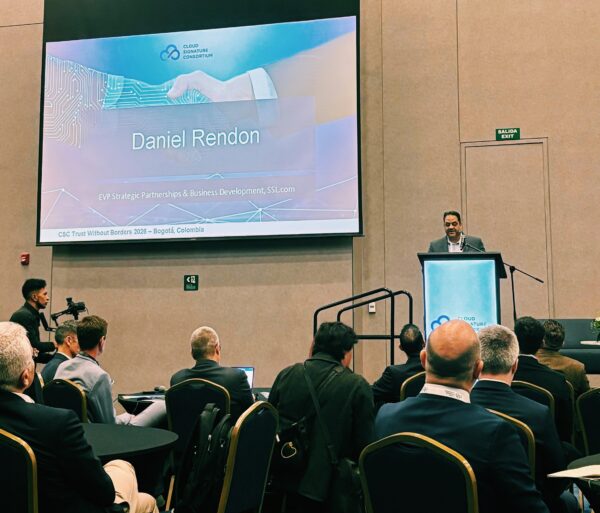
From Daniel Rendon, SSL EVP of Strategic Partnerships and Business Development:
Bogotá was definitely the right city for Trust Without Borders to convene. Latin America is at an inflection point, with regulatory frameworks maturing and invoice and e-signature mandates already driving broad PKI deployment at scale. The region’s governments and trust service providers are actively weighing how to connect their national systems to global interoperability standards. My presentation during the “Future-Proofing Digital Signatures and Digital IDs for 2030 and Beyond” session focused on media authenticity, multi-artifact cloud signing, and the extensible CSC API. In particular, I wanted to show not just where the CSC API has been, but where it is going and why that trajectory matters to every stakeholder in this ecosystem.
The core message I brought to Bogotá is one I believe deeply: the CSC API is no longer just a document signing standard. It is the universal cloud signing interface for every artifact type. Its original use cases for PDF and document signing are fully deployed and globally proven. However, the same open RESTful architecture that standardizes how signing applications communicate with remote HSM-backed keys can now support code signing in CI/CD pipelines and, more recently, C2PA manifest hash signing for media provenance. That is not a roadmap item. It is production infrastructure today. Interoperability is the language of trust, and a standard that travels across artifact types, regulatory jurisdictions, and technical ecosystems is precisely the kind of common language we’re trying to advance at the summit.
The media authenticity piece of my presentation addressed what is frequently framed as a governance and policy challenge: AI-generated content is now indistinguishable from authentic media at scale. This affects elections, journalism, and national security in measurable ways. As our EVP of Technology, Dustin Ward has put it: the answer is not “how do we spot what is fake,” it is “how do we prove what is real.” Regulation is accelerating that shift from defensive to offensive. The EU AI Act, California SB 942, Brazil’s TSE rules, and multiple other frameworks share a common thread: they all mandate machine-readable provenance, and C2PA content credentials backed by X.509 certificates from trusted CAs are the infrastructure those laws point to. The regulators at Trust Without Borders have a direct role in shaping how fast that adoption moves.
Looking ahead from this summit, what I am most focused on is the commitment side of the equation. The discussions here on post-quantum readiness, digital identity wallets, and bilateral recognition between LATAM and the EU are all conversations that SSL is built to participate in, but participation is not enough. I hope to leave Bogotá with real commitments from regulators, standards bodies, and industry partners to move from intent to deployment. SSL has been a digital trust platform for more than 20 years, and we sit at exactly the intersection where traditional PKI, content authenticity, and cloud signing converge. The opportunity in Latin America is real, the legislative pressure is building, and the infrastructure to act on it exists today.
Wednesday, May 13, 2026
From Daniel Rendon, SSL EVP of Strategic Partnerships and Business Development:
Right now is such an important time to talk about interoperability of digital signature and digital identity standards. I was honored to speak before regulators and industry leaders from across Latin America and around the world. I hope to return from Bogotá with real commitments from those in attendance to bring our world a little closer together with shared standards and trust frameworks.
Global trade is entering a fragmented and multi-global era. Businesses, governments, and citizens are increasingly engaging in trusted digital interactions that work across jurisdictions, languages, and legal systems. Countries are beginning to move beyond isolated national systems towards mutual recognition of digital identities and signatures. This is why this moment matters so much for Latin America and why Trust Without Borders is so timely.
Daniel Rendon will also present on Day 2 about how the CSC API is being used for emerging and future use cases, such as media authenticity.
From Luis Cervantes, Compliance Officer:
When it comes to interoperability, there are numerous standard bodies and compliance requirements, all at regional levels. While everyone is seeking interoperability solutions, many barriers and challenges lie ahead to bring all these regional standards together. From a compliance standpoint, a clear path forward isn’t yet evident. While you may have standards, it’s important to align on what they are being held up against.
For example, in our TLS realm, our CP/CPS serves as the standard used to assess WebTrust compliance within the audit framework. In that instance, there is a governing body that we can base our standards upon. That could also be a potential barrier to interoperability, along with technical and institutional factors.
Will a new governing body possibly need to be adopted to oversee global interoperability standards? I’m confident the discussions here will address these questions and roadblocks while identifying feasible solutions.
From Alex Levy-Thiebaut, Sr. Account Executive:
There’s really a stark difference between the continents. Europe has EIDAS, which mandates that every country have a European Digital Identity Wallet by year’s end. And shortly thereafter, all the regulated industries must accept it. Whereas, in the U.S., it’s really piecemeal. For example, the U.S. Department of Transportation has a digital ID, but not every airport accepts it.
So, consequently, it’s a very checkered map in the U.S., and every state is essentially doing its own version of a digital wallet. In Latin America, we see a lot of that, where countries have their own standards, such as Brazil. Argentina, Chile, and other countries do as well, but operability is not yet in the near future. That said, Europe is now a step ahead. The digital wallet has been a prevalent theme in discussions I’ve had here at Trust Without Borders. Regarding the EU digital identity, it has the maturity to enable scalability, and with the proven, known process it has, it could set the standard for other nations to follow.
If your work focuses on cross-border signing, identity assurance for multinationals, or content authenticity in regulated markets, connect with the SSL team to learn how we can help.