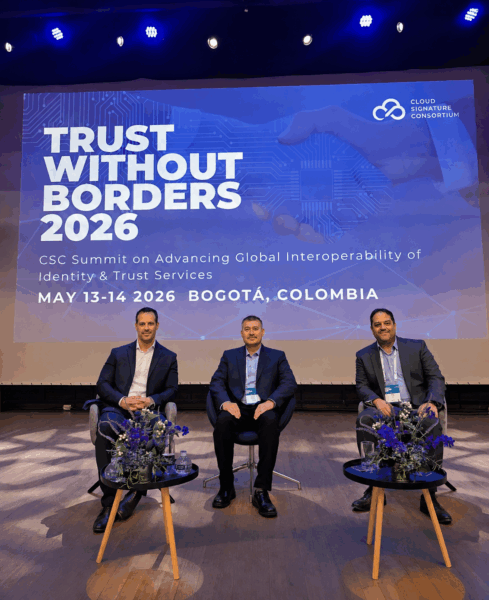
The Cloud Signature Consortium (CSC) brought its flagship global summit to Bogotá, Colombia, on May 13 and 14, 2026, and SSL was there as a regional host.
The event, Trust Without Borders, gathered more than 250 executives and 100+ organizations, including regulators, policymakers, PKI administrators, trust service providers, and technology leaders from across Latin America and the EU. The Bogotá summit reflected Latin America’s growing position at the center of the global discourse on digital transformation.
Why SSL Was There
SSL serves as a CSC member and regional host, and the team SSL brought to Bogotá covered the full breadth of organizational roles. Daniel Rendon, EVP of Strategic Partnerships and Business Development, participated as a CSC Board Member and took the stage as a featured speaker. Joining him onsite were Alex Levy-Thiebaut, Sr. Account Executive for the LATAM and EU region, Jose Masdeu, CA/System Administrator, and Luis Cervantes, Compliance Officer. Leo Grove, SSL’s President and CEO, also attended.
Rendon addressed attendees at the welcome and opening session on Day 1, framing the moment with urgency: “Global trade is entering a fragmented and multi-polar era. Businesses, governments, and citizens are increasingly engaging in trusted digital interactions that work across jurisdictions, languages, and legal systems. Countries are beginning to move beyond isolated national systems towards mutual recognition of digital identities and signatures.”
On Day 2, Rendon presented on how the CSC API is enabling new and emerging use cases, with a particular focus on media authenticity. As AI-generated content floods digital channels, verifying whether a piece of media is what it claims to be has become a core challenge for organizations across all major industries. SSL addresses this directly through its content authenticity solutions, including its C2PA Manifest Hash Signing Service, which protects media files with digital signatures that prove authenticity and content provenance. This capability directly ties to the interoperability infrastructure that the CSC community is building.
“It was the highest-attended by far of any event the CSC has had before,” Rendon stated at the event’s conclusion. “It has the most momentum to help the legislation advance. Andrea Valle, Senior Product Manager in Adobe’s Document Cloud business unit, announced the initiative to create a global interoperable standard for digital ID and digital signatures. A working group will be created to review regional standards and find common controls, engage with other standards bodies, and explore possible solutions that can achieve a truly global interoperable digital signature framework.”
What the Team Heard
The conversations, both on stage and between sessions, reinforced several tensions and opportunities that the global digital trust community is actively navigating. Luis Cervantes captured the complexity of the interoperability challenge from a compliance standpoint: “With everything currently intersecting in the digital trust space, this is the right time to discuss and advance truly global, interoperable digital signature and digital ID standards. These are often difficult conversations to have when discussing audit frameworks and achieving a true interoperability standard. Therefore, it was amazing to have candid, face-to-face conversations with leaders from Europe, Latin America, and Asia.”
Leo Grove pointed to a striking absence in the room. “There was an emphasis on LATAM and the EU. And oddly, North America, specifically the United States, was left out, which is unfamiliar for these types of global events surrounding the digital trust space. The silence was deafening, and it made a tremendous statement without saying a word. So, for the U.S. and digital identity, there is a lot of work to do to catch up with what other nations have done up to this point.”
Alex Levy-Thiebaut echoed that observation and connected it to the summit’s dominant theme: “The United States has a very light federal initiative compared to Europe, which has infrastructure, regulations, and national initiatives converging. Latin America has strong national norms but lacks a continent-wide unity that needs to be built. A primary summit focus was centered on the digital wallet. Participants are aware of the skyrocketing power of AI and how that poses immediate challenges for cybersecurity and encryption. It is not possible to fight tomorrow’s security battles with yesterday’s architecture.”
“We are in a very fractured world right now, so interoperable agreements between different regions, blocs, and nations are more important than ever because we’re conducting more cross-border trade with many people rather than just a handful of partners,” Rendon says. “Because of the fractured nature and the decentralization of what’s going on in current global trade, it’s especially good timing for Latin America because they have developed a bunch of regional interoperable agreements amongst each other. And there is the EU-Mercosur Partnership Agreement, which is one of the largest trade agreements in history between the Mercosur bloc in Latin America and the EU. So it’s a confluence of many simultaneous factors making interoperability a priority. They also have to begin considering the implications of post-quantum resilience in those standards. So we’re at an inflection point that says that this is the right time to talk about and really advance truly global interoperable digital signature and digital ID standards.”
What the Summit Built
Before the summit opened, attendees shared what they hoped to take away: collaboration, new connections, knowledge, and progress on standards. Looking back across both days, those expectations were met. More importantly, the conversations surfaced five trends that will define where this community directs its energy in the months ahead.
- Trust is not a technology problem. It is legal, supervisory, and evidential.
- The industry is shifting from signing to verifying, and from simply asking “who are you?” to asking “are you authorized?”
- Compliance is necessary but not sufficient. The path forward requires demonstrating real value for SMBs and citizens, not just regulated enterprises.
- Human-only identity frameworks are giving way to a world where AI agents, content, and connected objects are themselves signers and subjects of trust.
- Harmonization between regional standards is no longer the finish line. Mutual recognition between jurisdictions is.
Those five shifts frame both the challenges and the opportunities the CSC community is now positioned to act on, such as cross-border interoperability of many regional digital identity frameworks, content authenticity, and a global interoperability working group that was formally established as a direct outcome of this summit. The work that started in Bogotá continues, and SSL, along with the rest of the Trust Without Borders community, is committed to seeing it through.
To learn more about SSL’s C2PA content authenticity solutions, digital signing services, or Private PKI offerings, connect with the SSL team below.